

Message Transcript:
Paul introduces his letter in traditional, yet unorthodox manner. It was traditional in that he introduced himself and his position. It was unorthodox in that he declares the deity of Christ in it. It was traditional in that Paul mentioned praying to his God. This was common in communications in the first century – though of it was to a Greek or Roman god. But it is much longer and more involved than a typical letter introduction and prayer.
Last week we looked at the beginning of our text. This morning we will continue this introduction:
Romans 1:8–15 CSB
8 First, I thank my God through Jesus Christ for all of you because the news of your faith is being reported in all the world. 9 God is my witness, whom I serve with my spirit in telling the good news about his Son—that I constantly mention you, 10 always asking in my prayers that if it is somehow in God’s will, I may now at last succeed in coming to you. 11 For I want very much to see you, so that I may impart to you some spiritual gift to strengthen you, 12 that is, to be mutually encouraged by each other’s faith, both yours and mine. 13 Now I don’t want you to be unaware, brothers and sisters, that I often planned to come to you (but was prevented until now) in order that I might have a fruitful ministry among you, just as I have had among the rest of the Gentiles. 14 I am obligated both to Greeks and barbarians, both to the wise and the foolish. 15 So I am eager to preach the gospel to you also who are in Rome.
IN 2008, Laura got to go on the K-Love boat cruise with a friend from the church family. Sounds great, right? Well, it was for Laura. However, the circumstances of her going were less fortunate for some. Bruce had planned this cruise for himself and his wife and daughter – booking it well in advance to make sure they could have a spot. However, just before the cruise took place, Bruce was deployed – so Laura got to stand in for Bruce. While Laura was thrilled, I know Bruce sure would have loved to have gone on that cruise with his family.
Have you ever made plans and had them changed? Or worse, made plans and then had to cancel them because your work required you to do something? Or maybe you got sick and had to cancel your plans?
Usually at one of those moments, a Christian brother or sister, with the best intentions, quotes you a verse like Romans 8:28, right? Can anyone quote that for me?
Romans 8:28 “28 We know that all things work together for the good of those who love God, who are called according to his purpose.”
While the theology is good, it is not always the encouragement we want to hear, amen?
And I guess that is the point – whether or not we WANT to hear something doesn’t change whether it is true or whether it is good theology.
In his intro, Paul says he wanted to go to Rome, but God had not allow it… yet. Paul wanted to go to Spain, but we are pretty sure he never made it (at least we have no record if it). Paul wanted to go to Asia Minor at one point and “the spirit prevented him” from going.
Romans 1:13 “13 Now I don’t want you to be unaware, brothers and sisters, that I often planned to come to you (but was prevented until now) in order that I might have a fruitful ministry among you, just as I have had among the rest of the Gentiles.”
Paul even mentioned that he PLANNED to go to Rome multiple times – he said “often”. That means he not only made plans, but his plans were disappointed. Planning a trip in those days was not an easy task. I am sure that Paul was super disappointed when the plans failed the first time… and the second time… and the third time.
But God had a reason for all of it. Paul knew that. We know that. But how do we deal with that?
Paul did a few things:
He prayed – God IS in control, whether we want to admit it or not, whether we like our circumstances or not. I have learned that it is a much better idea to talk to God about it than to just complain about it.
Romans 1:10 “10 always asking in my prayers that if it is somehow in God’s will, I may now at last succeed in coming to you.
He prayed for God’s will – If God wills it, I will come to you.
While we get a glimpse in many of Paul’s letters about how he prayed for them, this one I really love because it resonates with me. I pray… “that God’s will ….” God did not always send Paul where Paul wanted to go. Paul knew that the important thing was doing what God wanted.
Military – your lives are upside down at times with plans, right? You make decisions about your career path, where you hope to go next. You study the school systems, check out housing and communities, and even the weather 😏. Perhaps this is a good reminder that it really does not matter WHERE you end up – as long as it is where God wants you.
We can all have dreams, goals, aspirations – just like Paul did. But in the end, the most important thing we can pray for is God’s will to be done. Jesus told us this is how we ought to be praying:
Matthew 6:9–13 CSB
9 “Therefore, you should pray like this: Our Father in heaven, your name be honored as holy. 10 Your kingdom come. Your will be done on earth as it is in heaven. 11 Give us today our daily bread. 12 And forgive us our debts, as we also have forgiven our debtors. 13 And do not bring us into temptation, but deliver us from the evil one.
There was nothing wrong with Paul’s desire to go to Rome and Spain. There was nothing wrong with him asking God to allow him to. But just because God CAN do something, even if it seems like a great benefit to His kingdom, does not mean he must do it. When Jesus prayed in the garden, before being crucified, he said this:
Mark 14:36 “And he said, “Abba, Father! All things are possible for you. Take this cup away from me. Nevertheless, not what I will, but what you will.””
His ways are higher than our ways, and his plans will prevail. Our prayer should be to align ourselves with his plan. In the end, we need to ask ourselves, “Do I really believe my theology?”. If Romans 8:28 is true then I should want God’s will to be done. Even in my disappointment may attitude can be gratitude and trusting in God.
Why did Paul want to God to Rome?
Romans 1:11–12 CSB
11 For I want very much to see you, so that I may impart to you some spiritual gift to strengthen you, 12 that is, to be mutually encouraged by each other’s faith, both yours and mine.
God is my witness… that I pray continually that I might get to see you. FOR THE PURPOSE OF:
- “I might invest in you”
- “we might invest in each other”
Notice, that the leader is never above learning from others. Paul was an apostle. He met the risen Savior. He was a scholar of the Scriptures. YET he knew he could be encouraged by the believers in Rome.
Paul wanted to encourage, but he also looked forward to being encouraged.
That is a healthy mindset for the church. Notice, that the most effective way for mutual encouragement to happen, requires proximity. While it is possible to be encouraged through an online message, or a text, or an email – or a letter like Paul is writing, there is a much greater capacity for encouragement when we are together.
One of the things I love about our small groups is the mutual encouragement that we all have. It is what the BODY is meant to be!
1 Thessalonians 5:11 “11 Therefore encourage one another and build each other up as you are already doing.”
Is it your desire to be with other believers and not only be encouraged, but also to be an encourager? I pray that it is! If so, either get into a group that exists, OR get with me and we will see if we can start another group.
Hebrews 3:13 “13 But encourage each other daily, while it is still called today, so that none of you is hardened by sin’s deception.”
How do we encourage each other in the faith?
One way to encourage one another is by accepting each other
As we reach verse 13 we have a bit of a transition. Paul started by declaring his authority as an Apostle. He referred to his audience as the “church in Rome” and “saints”. But in verse 13 the tone changes from authoritative to familial. It is not Paul, the Teacher, it is Paul the brother.
Romans 1:13 “13 Now I don’t want you to be unaware, brothers and sisters, that I often planned to come to you (but was prevented until now) in order that I might have a fruitful ministry among you, just as I have had among the rest of the Gentiles.”
Though Paul has not met them, and he has had nothing to do with their church, and they are Gentiles and not Jews, Paul is consistent with his theology and with the power of the gospel. If they have accepted Jesus they are brothers and sisters. What a great affirmation and encouragement.
Another way to encourage one another is to share the gospel with each other.
Romans 1:15 “15 So I am eager to preach the gospel to you also who are in Rome.”
If Paul just referred to them as “saints” and as “the church” and as “brothers and sisters”, why would be need to preach the gospel to them in Rome?
Remember, “gospel” is “good news”. The gospel is that we can be saved. But once we are saved it is also about how we are being saved, and then about how we will one day be saved. Preaching the gospel to each other, reminding each other of what Jesus has done for us and who we are now in Christ, is a great way to encourage each other.
I do not want to get into it too much, because that is Justin’s message for next week. But to preach the gospel among them is to share what Jesus has done, is doing, and will do for those who choose to call him Lord.
Paul’s theology influenced his relationships – how he viewed people and what he communicated with them.
While Paul sets up the letter by talking about his prayers to God, like some Romans did, and mentioning his desire to share in mutual encouragement, he also managed to set a foundation of what this faith and gospel look like. It is hidden to us, but would probably not be lost to his audience.
Romans 1:9 “God is my witness, whom I serve with my spirit in telling the good news about his Son—that I constantly mention you,”
Paul could have said, “God is my witness that I constantly mention you…” But instead, Paul has this seemingly odd phrase stuck in the middle of that thought:
“whom I serve with my spirit in telling the good news.”
This statement is really a tremendous example of how to properly contextualize the scriptures without compromising its truth. In it we have at least 3 elements of Greco-Roman culture that Paul addresses and reframes in light of a Jesus centered, Messianic worldview which he will unpack in the chapters to come.
“Whom I serve”
Serve (worship). To the Romans, their leader was “god” and was to be worshiped.
Emperor worship was a key part of Rome state religion. Generally referred to as the imperial cult, it regarded emperors and members of their families as gods. Starting with Caesar and Augustus emperors that considered themselves gods…
~ https://europe.factsanddetails.com/article/entry-1172.html
Nero, who reigned from 54-68 AD (during the time that Paul was writing this letter), demanded that people worship him as a god. Of course, this would not be acceptable for Jews or Jesus followers and is one of the reasons the Jews were persecuted. It wasn’t until Constantine, in the Edict of Milan in 313AD that Christianity was protected in Rome.
Paul’s declaration of worshipping/serving God instead of Rome was a significant statement that we do not live for our government, or any political ruler, we live for and worship the one who allowed them to be in leadership. (A topic he will expound on in Chapter 13).
“with my spirit”
Spirit. “Pneuma” – is translated at wind, breath, spirit, ghost, demon and soul in our New Testament. We have the word “pneumatology” that we use to describe the study of the spirit, and in particular, the Holy Spirit – that spirit which is set apart from all other spirits as the spirit of God.
While Paul many times refers to serving others and obeying God through the power of the Holy Spirit, this phrase is peculiar. In this verse he talks about serving God in “my spirit”. Does that mean he was not serving in the power of the Holy Spirit? Of course not! So why the use of this phrase?
Paul was writing to the church in Rome. The Greco-Roman culture viewed the make of a “person” (human ontology) differently than the Hebrew scriptures did. The Hebrew scriptures have a holistic approach where body, soul, and spirit are all one being. The Roman world, much due to the influence of Plato’s writing, has a dualistic view of humanity. They are body and spirit/soul. The spirit is the real person, and the immortal, trapped inside the physical and mortal body of humanity.
“The soul, whose inseparable attribute is life, will never admit of life’s opposite, death. Thus the soul is shown to be immortal, and since immortal, indestructible.” ~ Plato, Phaedo
So, to the Romans and Greek philosophers, the spirit or soul of a person (pneuma) was the real person. The soul was the source of life and the center of a person.
Paul, was not declaring a ministry apart from the Holy Spirit, nor carried our in his own power, but was speaking in the language of the church in Rome, to help them understand that his existence, his mission, life, his very person was surrendered to God for the work of sharing the good news about Jesus.
“in telling the good news about his Son”
Good news. “euangelion” Paul worshiped and served God with his entire being, his eternal being, by proclaiming the good news of the Messiah.
The imperial cult of Rome used the term “good news” most significantly in relation to the emperor, who was supposedly embodying divinity, good fortune, and salvation. The proclamation of the emperor’s birth, coming of age, and especially his accession to the throne were all heralded as “good news”. His enthronement, which was seen as introducing a new era and bringing peace to the world, was considered a “gospel for men”.
~ Middendorf, M. P. (2013). Romans 1–8 (D. O. Wenthe & C. P. Giese, Eds.; p. 86). Concordia Publishing House.
This is most clearly demonstrated in a calendrical inscription from Priene dated to 9 BC, which dramatically praised Emperor Augustus’s birthday as “the beginning of everything” and claimed that the universe would have welcomed destruction if Caesar had not been born to be the “common blessing of all men”.
English Translation:
“The birthday of the god [Augustus] was the beginning of the good news (euangelion) for the world because of him.”
Early Christians subverted imperial language to proclaim a radically different kind of kingdom—one not built on conquest, but on grace and truth.
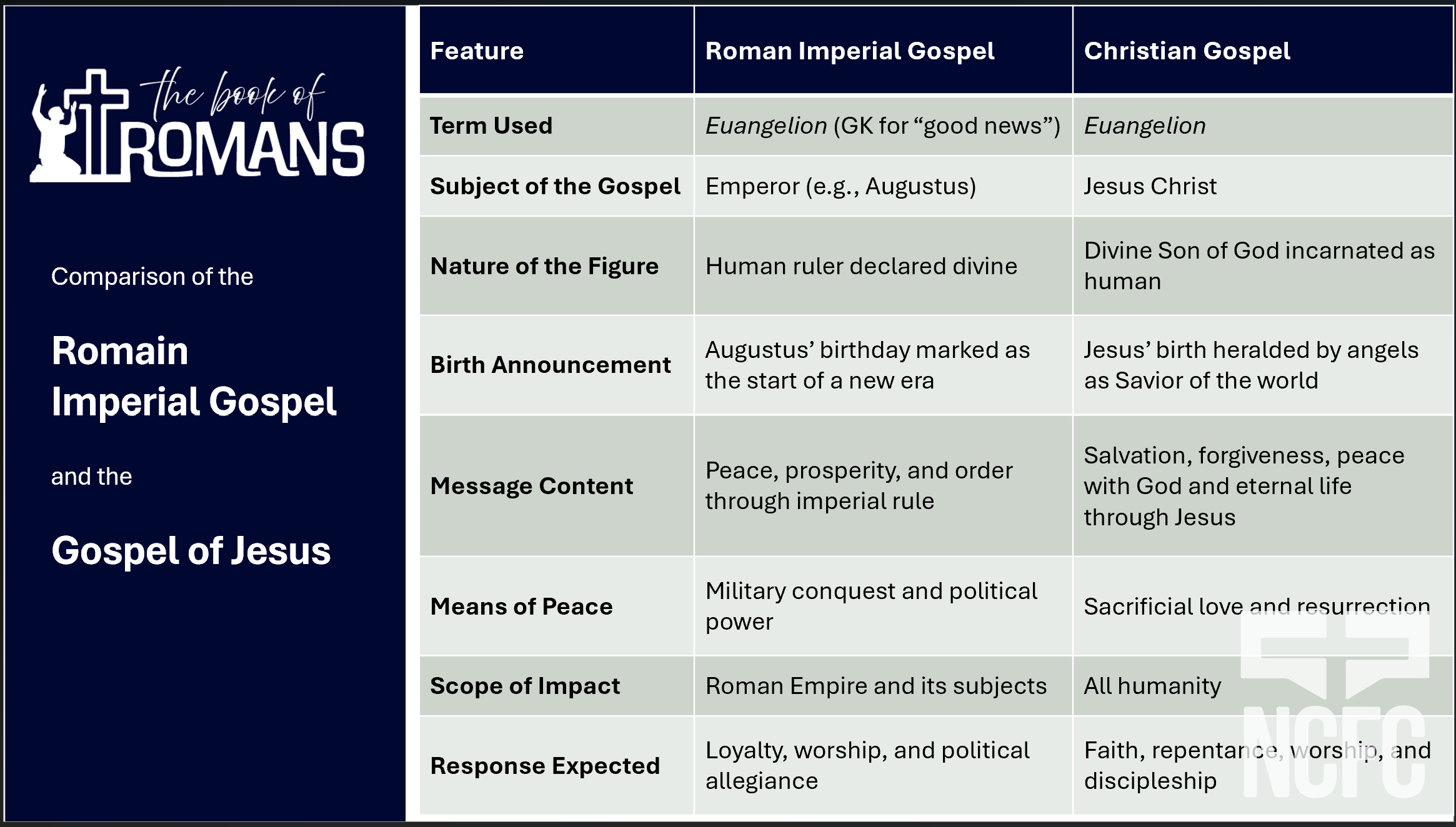
Paul was clearly declaring that for Christians, good news of peace, a peace greater than the Pax Romana (peace of Rome) is found in the person and work of Jesus. Paul uses the word “peace” 11 times in 11 verses in the letter to the church of Rome.
What I LOVE about Paul’s introduction is that he uses his theology to redefine cultural understanding – not the other way around. Culture is not the lens by which we define truth or formulate theology. God’s truth is the foundation from which we seek to shape our theology and our culture. This is referred to as a “theological world view” and is desperately needed today.
We start with the Gospel, and we apply it to culture. Never altering the word of God, but in hopes of altering the way we live and the world around us. Our Biblical understanding must first shape OUR world view or it will never influence the world around us.
- The value of every life, including those not yet born, must come from God’s view of life. Every life is sacred.
- The way we define marriage and marriage roles must come from God – who established both.
- Our understanding of morality, biology, social responsibility, integrity are rooted, and must remain rooted, in the teachings of the Bible.
A theological world view starts with Christ, the gospel, the Word of God and then applies Biblical truth to our culture. It does NOT try to shape theology based upon an “enlightened” cultural perspective such as Friedrich Nietzsche proposed, or movements like “Deconstructionism” such as Jacques Derrida posited.
Paul did not adjust his theology to make it fit the Roman culture. He showed how the Jesus culture superseded the culture of Rome, and later in the letter will explain who the Jesus culture needs to be influencing and reshaping the Greco-Roman culture.
Culture should not influence theology; rather theology should influence culture.
As we wrap up this passage, we see that Paul did not just have a Biblical worldview, he had a theological world view.
His theology informed his prayers. He knew what HE wanted but knew that what God wills is what is most important. His knowledge of God and God’s will informed his prayers and the way he handled disappointments.
His theology informed his relationships. Paul opened his letter stating that he longs to be with the brothers and sisters in Rome so they can encourage each other by sharing their faith and the gospel with each other. Though and Apostle and leader in the church, he understood that in Christ there is no distinctions based upon education, nationality, position, or geography.
His theology informed his worldview. His understanding of God, the Messiah, and his salvation shaped the way that he viewed the world and interacted with his culture. This gospel of the Messiah, is the real good news that brings peace and ushers in an eternal kingdom. It is something we should never compromise on, and something we should not be ashamed to share.
If God wills… we will look at THAT next week.
Do you have a theological world view?
How does your theology inform and shape the way you handle disappointment, relationships, and culture?